

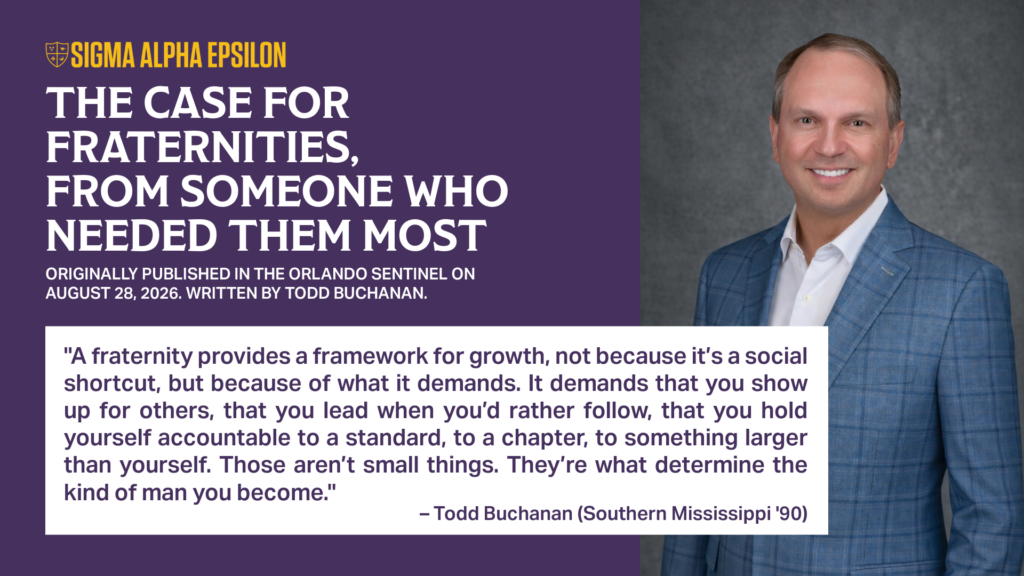
The Case for Fraternities, From Someone Who Needed Them Most
ORIGINALLY PUBLISHED BY ORLANDO SENTINEL ON AUGUST 28, 2026 AT 5:30
I was 14 when the bank foreclosed on our home and repossessed our cars. By 15, I understood that what was happening in our house wasn’t normal, that an unemployed, alcoholic father wasn’t something every family carried.
None of this is for sympathy. It’s here because the story of what I became is inseparable from where I started, and because the institution that helped me get there deserves to be recognized.
Recruitment season is starting on campuses across the country. In the next few weeks, hundreds of thousands of freshmen, many of them arriving without any family history of college at all, will decide whether to walk into a fraternity event or skip it.
Like some of those young men, neither of my parents went to college. There was no one to call when I didn’t understand the financial aid process, no family friend to introduce me to the right people, no inherited map for navigating my early undergraduate days. When I arrived at the University of Southern Mississippi, I was largely on my own. My situation was similar to that of many first-generation college students walking onto college campuses this fall.
What I didn’t know was that I would soon find something outside the classroom that would seriously alter my life trajectory. In a striking act of generosity, the bank president who repossessed my family’s house and car paid for me to join his old fraternity, Sigma Alpha Epsilon. I quickly found brotherhood and became surrounded by young men with standards, peer accountability that held me to them, and a framework to become the kind of man I didn’t have a model for growing up.
I quickly found brotherhood and became surrounded by young men with standards, peer accountability that held me to them, and a framework to become the kind of man I didn’t have a model for growing up.
What critics of fraternities rarely mention and most people outside the Greek community never see is the infrastructure that exists behind the letters. SAE maintains crisis management support services for young men navigating some of the hardest moments of their lives. There are mental health resources, risk management programs, and chapter chaplains who provide real pastoral support. For a kid like me, who grew up in a home where asking for help wasn’t always easy, that safety net mattered.
But the fraternity provided more than a net to catch me. It set expectations, connected me with mentors, and surrounded me with peers who challenged me.
Saying yes to nearly everything Southern Miss offered felt necessary. I understood I couldn’t afford to waste what I’d been given. I was elected fraternity president by my brothers, then ran for and won student body president. The connections, and the standard I was being held to, ran back through that fraternity house.
After college, I entered the U.S. Army as an artillery officer. There is no question that there is a direct line between the discipline, accountability and sense of shared mission I first encountered in a fraternity house in Hattiesburg, Mississippi, and the officer I became. Similar to the Army, SAE was filled with young men from all walks of life; every economic background, faith, and ethnicity were represented. My experience learning to assimilate and compromise, especially in leadership roles, proved instrumental as I began to lead my platoon. I eventually left the Army and entered the private sector.
A kid with a tough childhood, no connections, no roadmap, and no inherited advantage can walk into a fraternity as a first-generation college student and walk out as someone capable of leading men and women in combat and leading companies in business.
A kid with a tough childhood, no connections, no roadmap, and no inherited advantage can walk into a fraternity as a first-generation college student and walk out as someone capable of leading men and women in combat and leading companies in business. That’s not a hypothetical. It’s the specific arc of my own life, and I don’t think it’s an unusual one for members of a collegiate fraternity. The transformation isn’t magic, and it isn’t really about the letters on the house. It happens because someone hands you responsibility before you feel ready for it, because your brothers hold you to commitments you’d otherwise quietly let slide, and because failure in front of people who know you becomes a kind of pressure that turns into character over time.
A fraternity provides a framework for growth, not because it’s a social shortcut, but because of what it demands. It demands that you show up for others, that you lead when you’d rather follow, that you hold yourself accountable to a standard, to a chapter, to something larger than yourself. Those aren’t small things. They’re what determine the kind of man you become.
Todd Buchanan of Tampa is President of AmeriLife Wealth and former national president and board chair of Sigma Alpha Epsilon Fraternity.
Guest Commentary: The case for fraternities, from someone who needed them most