

Editor’s Note: This article was originally published by San Diego State University/Fowler College of Business and can be viewed here.
“I grew up with two passions: gaming and basketball,” said Justin Taylor [California Theta] who graduated with a marketing degree from the Fowler College of Business at San Diego State University in 2005.
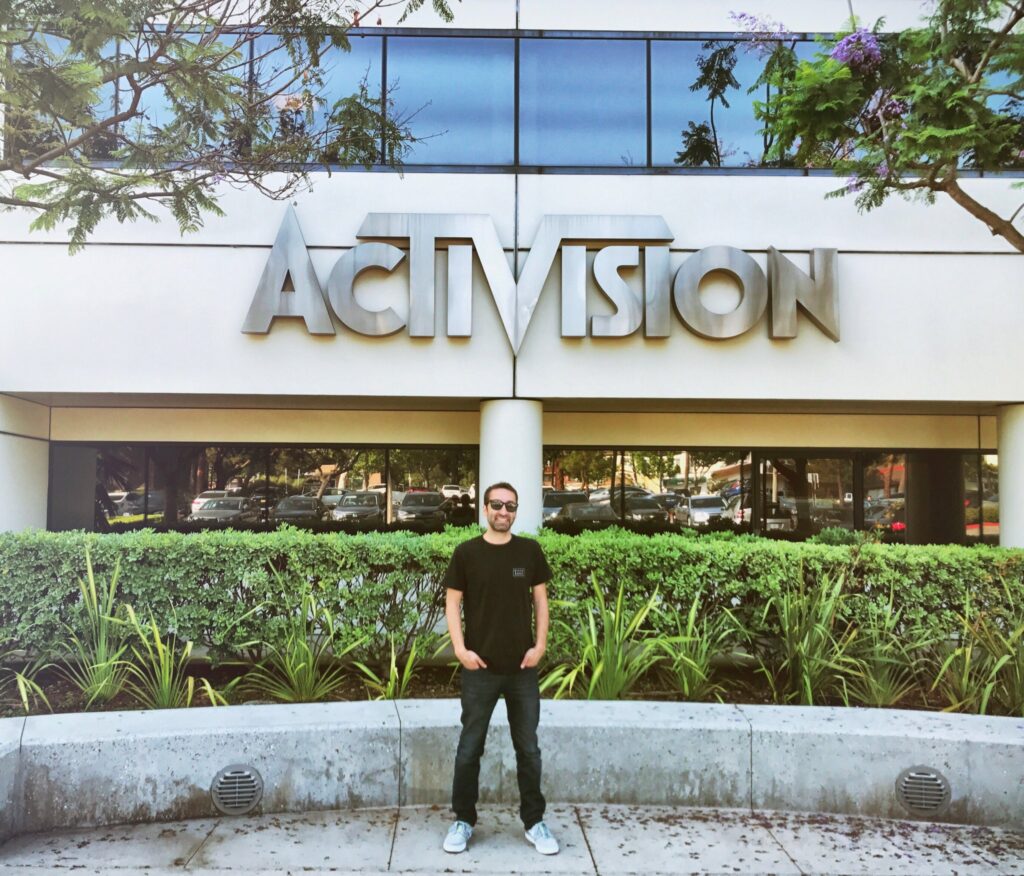
Throughout his career, Taylor has been fortunate to have held positions at two Fortune 500 companies that focused on both of his passions, having worked at Nike as a global brand director in their basketball division, and now, with Activision as a senior director of digital marketing.
In his position with Nike, he worked with some of the NBA’s biggest stars. With Activision, he currently oversees the digital marketing efforts for Call of Duty, one of the most popular video game franchises in history.
Proximity to the Beach/Outstanding Marketing Program Brings Him to SDSU
As a bonus, Activision’s headquarters are located in the beach community of Santa Monica, California, which was important to Taylor as he was growing up. Similarly, it was the proximity of SDSU to the local beaches that brought him to San Diego in the first place. “I grew up a beach kid and knew I wanted to go to school somewhere near the ocean,” said Taylor, a native of the Palos Verdes area near Los Angeles. “After taking a public speaking class in high school, I fell in love with the idea of marketing. From there, it was easy to pick SDSU, as it had the best undergrad marketing program in California.”
Taylor says he has many good memories of his years at SDSU, with one marketing professor being especially notable. “I took multiple classes with Matt Aistrich. His sales class sticks out in my mind,” said Taylor. “He was a great teacher who really challenged me on how I looked at advertising and how to approach problems from different angles.”
The lessons from Aistrich’s class came in handy at Taylor’s first job as an assistant account executive at a small San Diego marketing firm. It was also where he gained first-hand knowledge of creative media marketing before he moved back to the Los Angeles area to take a position with a larger agency 18 months later.
Landing a Position at Nike
While living in Los Angeles, a friend told him about an opening for a global digital brand director position with Nike’s basketball division that piqued his interest. “I grew up loving Nike as a brand and loved their commercials,” said Taylor. “I remember the first pair of Air Jordans I got as a kid and thinking that I was actually jumping higher as soon as I put them on. I was obsessed with basketball and I couldn’t think of a better place to dive into my passion.”Taylor landed the job and left Southern California for the Portland area to take a position at Nike’s world headquarters in the spring of 2014. “It was an incredible experience working in Europe, China and the U.S. on marketing campaigns for some of the world’s biggest athletes,” he said. “I traveled to China with LeBron, launched a basketball tournament in France, and spent time interviewing Kobe.”
While Taylor enjoyed his role with Nike and learned a lot about “storytelling, brand strategy and global campaign launches,” he also missed his friends, family and the weather in Los Angeles. In the spring of 2017, a career recruiter told him that Activision was looking to fill a management position in their digital marketing department. Since Activision is based in Santa Monica, California and he has a passion for gaming, the opportunity seemed almost custom-made for Taylor. In the summer of 2017, Taylor secured the position and relocated back to coastal Southern California, where he currently resides.
Back to the Beach
As with his former position with Nike, Taylor works with celebrities (music stars Steve Aoki, Post Malone and Pusha T, to name a few) in his current role. However, his primary responsibility is to oversee digital marketing and customer relationship management (such as social media, website content, email and in-game marketing) for Activision’s product line. Taylor says his favorite part of the job is working directly with the gaming community, “We have an incredibly passionate and creative community that honestly is second to none.”
For current SDSU students interested in pursuing a position with Activision, Taylor offers two words of advice: Innovation and communication. “The video game industry is a quickly evolving segment, which requires us to always think of new ways to reach our customers,” he said. “With our existing customers, we have to make sure we communicate clearly and continually because there are so many messages to share and stories to tell.”
Editor’s Note: The video above was created by Josh Peterson, an undergraduate at the San Diego State (California Theta).
Traveling abroad is a staple of the collegiate experience. Many students, including SAEs, are very fortunate to have the opportunity to visit another country to enhance their academic profile while experiencing a culture unlike their own. The chapter at San Diego State (California Theta) went abroad for a less conventional reason: philanthropy.
Josh Peterson (Service/Philanthropy Chairman) sought to take California Theta’s community service to the next level—to Rise Above. “We wanted to make a bigger impact on the community, to show what SAE is truly about,” he said. With San Diego being a mere 30 minutes from Tiajuana, it became apparent that helping those less fortunate in one of the world’s most crime- and poverty-ridden cities was going to be the core tenant of the chapter’s next philanthropic endeavor.
The chapter partnered with Homes for Hope, an organization that provides financial resources and labor to support low-income and impoverished communities in developing countries. Over 100 home have been built, enabling families to break the cycle of poverty. Between hosting events, their donation page, and additional funding from Clear Sky Capital, the chapter was able to send ten men to build a home.
For many of them, it was their first time out of the country. It is a stark cultural difference from San Diego to Tiajuana. “Witnessing poverty in person is something I will never forget,” Jake Ducharme (Health-and-Safety Officer) recalls, “it gives a new perspective on life and makes you appreciate what you have.” After meeting with the Valdez family, who would be benefitting from this home, they immediately got to work—building a liveable environment from the ground up is no easy task. The chapter was fed home-cooked meals from the family, who surprisingly also helped with the build.
The projects are typically done after the build is complete. However, they were fortunate enough to have leftover funds and used them to buy groceries and furnish the house. The Valdez family was in shock. After a tearful goodbye, the men headed back to San Diego State, but not without making it a goal to make this trip annual.
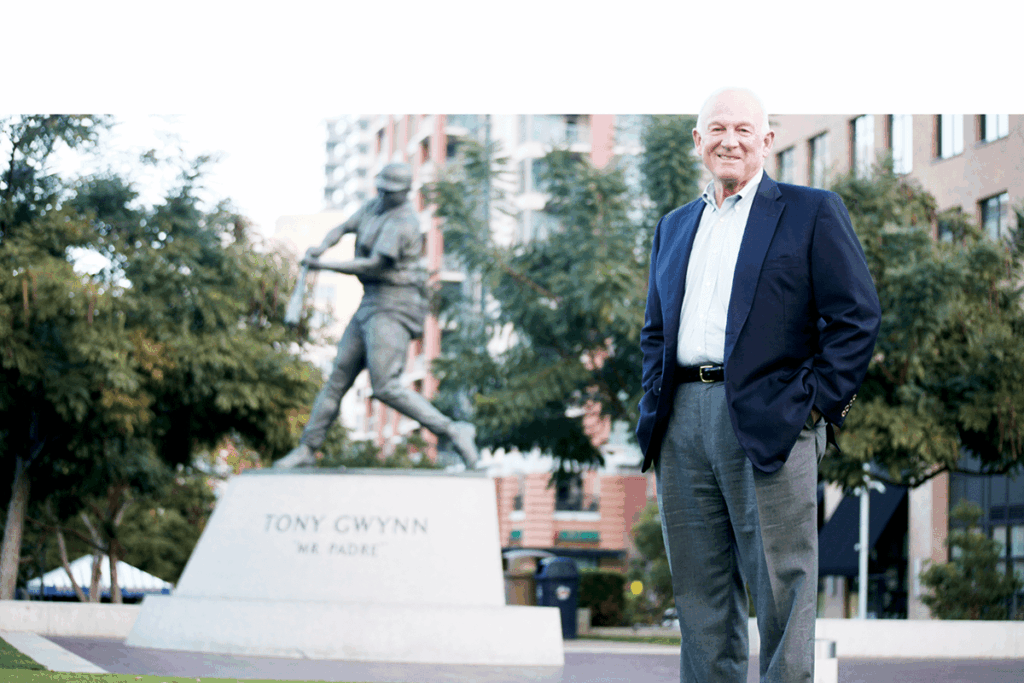
Brother Jerry Sanders helps revitalize San Diego to help the city stay classy.
The line “You stay classy, San Diego” from the movie Anchorman: The Legend of Ron Burgundy ranks right up there with other such memorable catchphrases such as “Here’s looking at you, kid,” “Go ahead, make my day” and “Run, Forrest. Run.”
No one has been more instrumental in helping San Diego stay classy than Jerry Sanders (San Diego State ’72), who has been protecting and serving the city for more than 40 years.
Sanders grew up in Long Beach, about 100 miles up the coast from San Diego. “Since I was from out of town, I didn’t have a real support system at San Diego State,” says Sanders. “Some friends on campus said, ‘If you join a fraternity, you build a whole new circle of friends, and it’s a good way to go.’ So I joined ΣAE and enjoyed it a lot. The friends I made are still friends to this day.”
During his final semester at SDSU, Sanders was hired by the San Diego Police Department and achieved his goal of becoming a police officer like his father. He ascended the department’s ranks, served seven years on the SWAT unit — two of them as commander — and at age 40 became one of the youngest police chiefs in San Diego history.
“We had a great national reputation because the police officers were working so closely with the community and bringing crime down dramatically,” says Sanders. “I talk to kids quite a bit, and I tell them that policing is the most exciting career you can ever imagine. You’re tested every day physically and mentally because people don’t call the police when everything’s going well. I found it to be an unbelievable experience. And when you look back on a career like that, you feel pretty good. You feel like hey, I gave it my all.”
Sanders retired as chief of police in 1999 and became president and CEO of the United Way of San Diego County. During his three-year tenure, he increased fundraising by 20 percent and stopped the organization’s eight-year financial hemorrhage.
Sanders helped another nonprofit regain its financial footing when he became chairman of the board for the San Diego/Imperial Counties Chapter of the American Red Cross in 2002. During his three years at the helm, he increased the chapter’s financial transparency and restored its credibility. Under his guidance, San Diego/Imperial Counties became the first debt-free chapter in American Red Cross history.
“I’ve known Jerry for about 45 years,” says Dick Troncone (San Diego State ’65), president emeritus of the San Diego Area Alumni Association of which Sanders is also a member. “I first met him when he was serving as Cal Theta’s Eminent Treasurer, and I was chapter adviser,” Troncone says. “Jerry has never turned me down when I have asked him to help with ΣAE, even when he was [exceptionally busy as] mayor of San Diego.”
With his reputation as a successful turnaround executive, civic leaders urged Sanders to enter a special run-off election after San Diego’s mayor resigned just six months into his term.
“I’d never been into politics before,” says Sanders, who ran for mayor in 2005. “The city was in a crisis. It was on the brink of bankruptcy and was being investigated by the Securities and Exchange Commission for what were classified as fraudulent bond filings.” Newspapers across the country were no longer calling San Diego by its nickname, America’s Finest City. Instead, they referred to it as Enron by the Sea.
Sanders won the election and immediately launched a top-to-bottom review of the city’s budget and streamlined city operations, which meant eliminating more than 1,800 positions to reduce overhead costs. During his two terms in office, city financial staff completed six years’ worth of backlogged audits, which allowed San Diego to return to the public bond markets in January 2009. This helped fund Sanders’ commitment to repair the city’s long-neglected water, sewer and transportation infrastructure.
Sanders also introduced “managed competition” to city government, a process that allows private companies to compete against city employees for the right to provide municipal services.
In September 2007, Sanders made the heartfelt decision to reverse his public opposition of same-sex marriage. “In the Republican world, that’s not the most popular thing,” he says. “My daughter, Lisa, is a lesbian, so it gave me an opportunity to do what I thought was right.”
In his press conference, Sanders said, “I couldn’t look [Lisa and members of my personal staff] in the face and tell them that their relationships, their very lives, are any less meaningful than the marriage I share with my wife, Rana.”
Sanders completed his second and final term as mayor in December 2012. Just one day after leaving office, he began his duties as president and CEO of the San Diego Regional Chamber of Commerce, the position he holds today. The San Diego Regional Chamber is the largest chamber on the West Coast, representing approximately 2,500 businesses and an estimated 300,000 jobs.
“Jerry is the ultimate public servant; he is most unselfish with his time,” says Troncone. “San Diego needs more citizens like Jerry.”
As Sanders looks back on his career, he credits his father for modeling what it means to be a strong servant leader. “I’ve found public service to be very fulfilling because I like working with people. I like being able to help achieve good outcomes. It’s a privilege to be able to serve in that way.”
“I’ve found public service to be very fulfilling because I like working with people. I like being able to help achieve good outcomes. It’s a privilege to be able to serve in that way.”
Sanders also finds it a privilege to keep in touch and continue to interact with Cal Theta brothers
during monthly luncheons hosted by the San Diego Area Alumni Association.
“The experiences I had in the Fraternity and the friendships I’ve kept have impacted my entire life. The leadership, the camaraderie, the brotherhood — all of it. That’s what fraternity has been to me and what it’s meant to San Diego State ΣAEs for a long period of time.”
Wise words from one classy brother.